Showing posts with label Bendigo. Show all posts

Sunday, 27 October 2013

The Bendigo Heritage Mosaic - Rosalind Park

Below the tower, in Rosalind Park, is the Bendigo Heritage Mosaic.

This section features artistic interpretations by the artist using gold as her inspiration

This mosaic represents the atomic structure of gold showing the nucleus and the six shells of the atom with their electrons
This mosaic shows quartz veins winding through the earth, containing gold in its various forms


Designed by Maery Gabriel, The Bendigo Heritage Mosaic was completed in 1987 by hundreds of volunteers from the Bendigo community. 
The differing background colours indicate the different ages of the rocks.
This mosaic is a stylised representation of the central area of the main Bendigo goldfield based on a geological plan. It shows the main lines of the reef including the famous Hustlers, Garden Gully and New Chum.


The mosaic depicts aspects of Bendigo’s mining history. 

Picked out in quartz are the saddle reefs for which Bendigo was so famous.
A typical cross section of the Bendigo goldfield is portrayed here.


It is designed to be viewed from above, on the first level of the lookout tower where there is more information displayed.

The mine layout in this design features part of the Garden Gully line of reef.
The mining of quartz reefs began in early 1853, and continued for 101 years, yielding about 17 million ounzes of gold.


Shown here is the Ironbark Mine on the Sheepshead reef. It has an interesting pattern of drives, stopes and winzes.The smaller mosaics are emblems representing some of the groups and nationalities present on the goldfields on those early days. Also included are designs showing local flora and fauna and items of historical interest to Bendigo.


These photographs really don't do the mosaic justice. When you come to Bendigo it is worth the climb up the tower for the view and to get a good overview of the mosaic.

Talk again soon

Jeanette


Sunday, 20 October 2013

Police Barracks, Rosalind Park, Bendigo

Bendigo Senior Secondary College is located abutting Rosalind Park and I went there for two years. I can honestly say that I never noticed this building sandwiched between my school and the Camp Hill Primary School next door. Now that I have found it I would like to share it with you.


Police Barracks Lane

Barracks Lane is right in the heart of the old Camp Reserve and was the earliest administrative centre of the Bendigo goldfield. 

Police Barracks # 2Police Barracks # 1


A short distance up this lane are the old police barracks, built in 1859 using local sandstone. 

Police Barracks down pipe detail
Police Barracks # 3


Back then the barracks would have been conveniently close to the old Supreme Court building which can be seen from the western side of the fernery. 

Police Barracks # 4
Police Barracks # 5


Looking back into the park there is a good view of the avenues of trees that were planted in the latter half of the 19th century. 

Police Barracks lane, Rosalind Park
through the park to Police Barracks Lane


While the numerous elms (Ulmus x hollandica) and oaks (Quercus canariensis x Q robur) are the most numerous tree species, the Park does have other interesting tree species to look out for: African Yellowwood (Afrocarpus falcata), an avenue of ten mature Canary Island Pines (Pinus fanariensis), Australian Teak (Flindersia australis), Bunya-Bunya Pine (Araucaria bidwillii) and Queensland Kauri (Agathis robusta).


Rosalind Park pathways


I hope you have enjoyed this look at this wonderful building from our Gold Rush era and some pictures from Rosalind Park.

Talk again soon

Jeanette

Sunday, 13 October 2013

Lookout Tower, Rosalind Park, Bendigo

The present poppet head lookout tower was erected in 1931. It was shifted from the Garden Gully United mine which was one of Bendigo’s richest. 

Lookout Tower, Rosalind Park, Bendigo
 .
During the gold rush a flag was flown from the top of Camp Hill to signal the arrival of mail. Because of the absence of trees which were cut down for the mines, the flag could be seen from all parts of Bendigo.

Lookout Tower, Rosalind Park, Bendigo

Looking across Rosalind Park from the Lookout Tower you can see the clocktower on the old Post Office, the flag on the historic Shamrock Hotel, the old Town Hall (in the background on the left) , and  the red building is St Pauls Cathedral (in the background on the right).

Rosalind Park, old Post Office, Shamrock Hotel, old Town Hall, St Paul's Cathedral

Old Post Office, Shamrock Hotel
Old Town Hall


To the left of the old Post Office is the Bendigo Law Courts (with the arches).

Law Courts

And further along to the left, the building with the tower, is the TAFE College.

TAFE College

 Looking in the other direction is the Sacred Heart Cathedral with its 87 metre spire reaching skywards.

Sacred Heart Cathedral

I hope you have enjoyed this quick overview of the view from the tower. I will share more details on each of these buildings at a later date.

Talk again soon

Jeanette

Sunday, 6 October 2013

The Fernery, Rosalind Park, Bendigo

One of my favourite places within Rosalind Park is the fernery. On a hot summer day it is a lovely place to be because the foliage keeps out the sunlight and the water flowing through helps to keep the temperature down. Here are some pics from me and text from Bendigo Tourism.

At the northern end of the Park is the granite gateway (known as the Good Mother Gateway) leading into the fernery.


signage on the "Good Mother Gateway"

 In 1879 G S Mackay who was a leading authority on ferns proposed the establishment of a fernery in an area known as, The Willows, which was once a bend in the Bendigo Creek. 

gateway leading into the fernery

The billabong was levelled and transformed into an open air fernery where mature trees now provide a canopy of shade for the more tender ferns. 


a pool of water that is pumped throughout the fernery

The area has a luxuriant character with its water features, bridges, rockeries, gravel paths and a fern and palm collection.

water flows over waterfall, under bridge and into poolwaterfall on left of bridge

My sister was married in front of the bridge pictured above, 25 years ago last January.

The River Red Gums (Eucalyptus camaldulensis) growing in the fernery are the remnants of the original vegetation of the Bendigo Creek and are of historical significance. 


large tree giving shelter to the plants underneath

 This fernery remains the last surviving fernery garden in Victoria that was established on public land from this era. 


a spot of colour

As you leave the fernery pause to take in the aesthetically significant vista of the Park with its retained 19th century layout, its significant plantings, some dating from the 1870’s, its different levels of horticultural intensity and its interface with the magnificent 19th century street scape and significant government buildings.


still a bit thin after drought

Due to drought the foliage is still a bit thin in spots but is slowly filling out. This is one of my favourite places although the bats roosting in some of the trees creates a bit of a smell.

Talk again soon

Jeanette

Sunday, 29 September 2013

Bendigo Creek, Rosalind Park, Bendigo

This week I thought I would share with you the historic Bendigo Creek. Thanks again to Bendigo Tourism for the text. The photos are mine.

The three iron bridges over the creek link the historically significant Rosalind Park to the surrounding 19th century street scape. 


They were built in 1882 to replace earlier narrower structures. 


A Royal Commission recommended the construction of a timber box drain along the realigned creek in 1857, completed in the early 1860’s. 


Later, to improve channel drainage, the creek was widened, lined with flagstones and walled with sandstone capped with granite. 


This is a significant example of late 19th century urban infrastructure development and stone masonry.


I know these bridges well having crossed them numerous times in the two years that I studied at Bendigo Senior Secondary College, the same school my daughter now attends. During extremely heavy downpours the creek can run the full width of the bed and part way up the walls. This all eventually flows out to White Hills.

Talk again soon

Jeanette

Monday, 23 September 2013

Conservatory Gardens, Bendigo

Hello all. Here is my first post about my home town in Bendigo. The following pictures were taken by me with not the best camera in the world but they should give you an idea. The text I have borrowed from a leaflet produced by Bendigo Tourism.

The ornate conservatory building was erected in 1897 and is the last such building in existence in a public park in Victoria. Special floral displays are exhibited here throughout the year.


The cast iron fence was erected in 1878 enclosing land that was once used as a rubbish tip.


The Washington Fan Palms (Washington filifera, a native of Arizona and California) were planted in the late 1800’s.


The beds under the palms are now used to showcase the city’s spring tulip display.


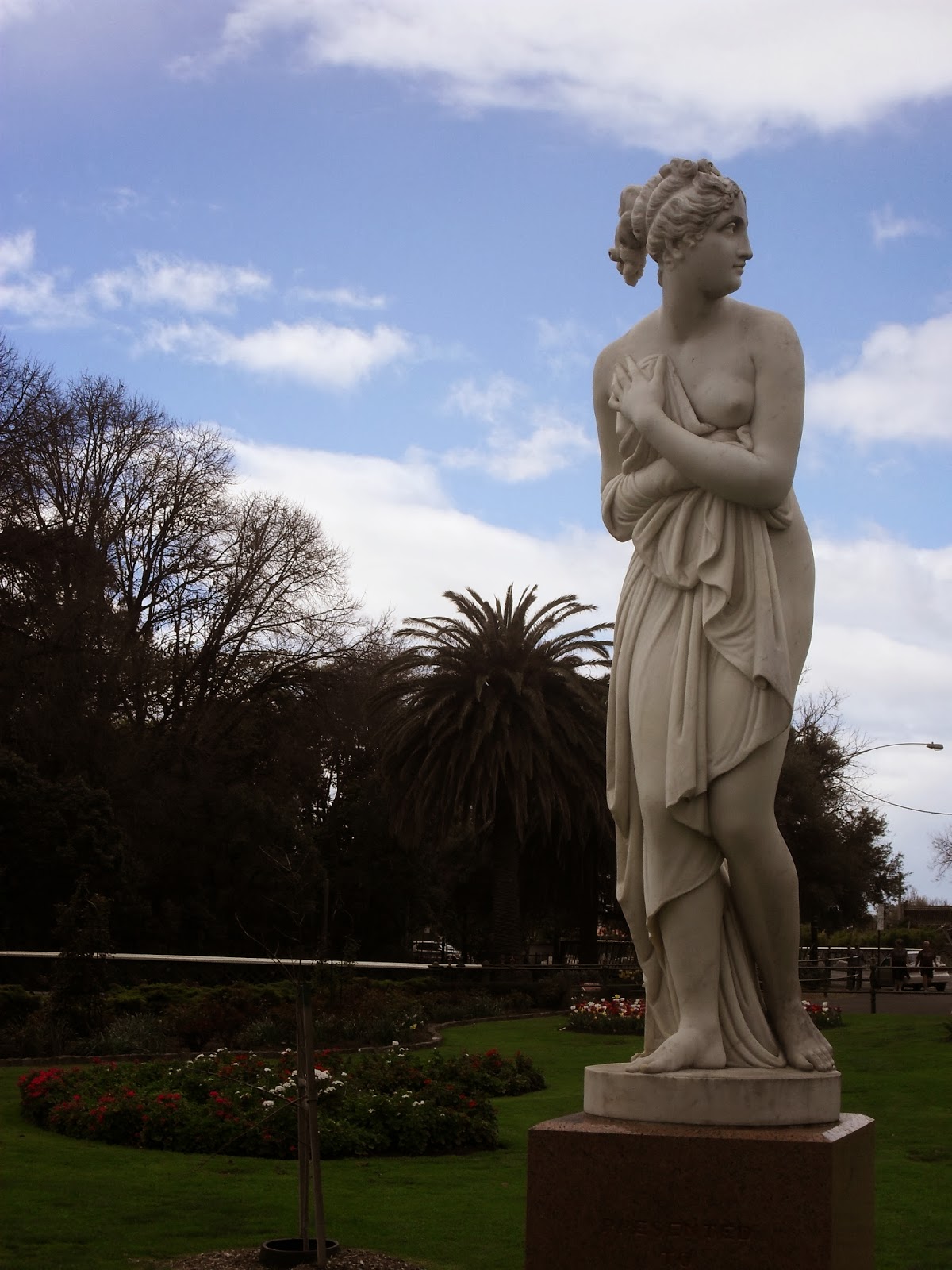
The garden has retained its 19th century statuary, garden baskets and conservatory building.


As stated above, the Conservatory itself has different displays in it at different times of the year e.g. Chrysanthemums on Mothers Day. After my brother's wedding our family went there to take pictures and it was beautiful.


And so ends my first post about a Bendigo attraction. I hope you enjoyed it. Come and visit sometime.